 Becoming a Space Faring Society Ejner Fulsang Saturday, May 9, 2026 2:30 PM PACIFIC TIME ********************************************^^^^^^************ This is a Zoom meeting. Please register: https://m-wise.click/MAY You will receive a confirmation email with the logn information. |
Becoming a Space Faring Society Is there a need for us to migrate into space? Ejner will discuss the reasons we will need to spread beyond the Earth if humans are to survive. What technologies we will need to develop and the adaptations we will have to make. Ejner Fulsang. was an Army helicopter pilot in Korea from 1969-70, later attending West Point where he graduated in 1974 with a BS in Engineering. After leaving the army in 1979, Ejner spent the next 20 years working in engineering and marketing. He spent the last ten years before retiring as a proposal manager at NASA Ames and SETI helping scientists write proposals for space missions. He is most proud of his contributions to the Icebreaker mission which was designed to search for microbial remnants of life on Mars. Twenty years ago, Ejner took up writing. He writes in the hard SciFi genre where all science and technology must be plausible. The Galactican Series depicts the scientific, technological, and societal evolutions that a society will have to make in order to become a true spacefaring society. |
|
 Science at 17,500 MPH: Performing Payload Operations on the International Space Station Cameron McCarty Saturday, June 13, 2026 2:30 PM PACIFIC TIME ********************************************^^^^^^************ This is a Zoom meeting. Please register: https://space-talk.link/JUN You will receive a confirmation email with the logn information. |
.
|
Science at 17,500 MPH Performing Payload Operations on the International Space Station Since 1998, more than 4,000 scientific investigations and experiments have been completed on the International Space Station. These investigations range from K-12 experiments to world-class research by a variety of institutions. Organizing and operating the variety of science on orbit requires coordination of timelines, managing requirements, scheduling, ground commanding, and ensuring the experiments are safely executed. Cameron will cover what type of experiments are run, how transmissions to communicate with the crew are handled, why the ground controllers continuously monitor the scientific instruments, and how experiments can even be run from the ground while the crew sleeps. Cameron McCarty received his Master’s in Planetary Geology from the University of Tennessee at Knoxville and a bachelor’s from Columbus State University. He started his career commanding the microscopic imager on the Mars Rover Opportunity which sparked his love for operations. He then moved into the world of crewed flight operations supporting the International Space Station (ISS) as an Operations Controller. Since 2023, Cameron has served as a Payload Operations Director. In this leadership role, he is responsible for leading the team in Huntsville, Alabama, that provides 24/7 support for scientific research on the ISS. His team ensures that the astronauts onboard can successfully perform world-class science and other critical experiments, contributing to scientific discovery and technological advancement |
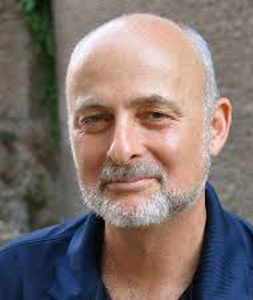 Can organic humans "augment" to keep up with AI? David Brin Saturday, July 11, 2026 2:30 PM PACIFIC TIME ********************************************^^^^^^************ This is a Zoom meeting. Please register: https://space-talk.link/JUL You will receive a confirmation email with the logn information. |
Can organic humans "augment" to keep up with AI? Even if the new wave of artificial intelligences fall short of omniscience, they're going to seem awfully godlike. So, what are we member of the Olde Race to do? Maybe keep up with these new children of our minds? Some glimmering indications from biology to the quantum suggest that - maybe - we can. David Brin is an astrophysicist whose international best-selling novels include The Postman, Earth, Existence and Hugo Award winners Startide Rising and The Uplift War. A Caltech Distinguished Alumnus, David consults for NASA, companies, agencies and nonprofits about how science, technology and evolving values will affect our onrushing future. His first nonfiction book, The Transparent Society, won the Freedom of Speech Award. Another is Vivid Tomorrows: Science Fiction and Hollywood. His new book on AI will be about raising these new entities to be good citizens |
|
 To-Space, Through-Space Dr. Harold “Sonny” White Saturday, August 8, 2026 2:30 PM PACIFIC TIME ********************************************^^^^^^************ This is a Zoom meeting. Please register: https://space-talk.link/AUG You will receive a confirmation email with the logn information. |
To-Space, Through-Space How will we travel through space>? Can we reach beyond the solar system? The talk explores the perennial time-distance problem of human space exploration beyond Mars and to identify a few propulsion approaches we might utilize to send humans to all the worlds in our solar system and reach out across the vast distances between stars. The spacecraft architectures highlighted in the talk are nuclear electric propulsion (known physics, known engineering), fusion propulsion (known physics, unknown engineering), and finally space warps (unknown physics, unknown engineering). Dr. Harold “Sonny” White is a physicist and aerospace engineer specializing in advanced propulsion, particularly warp drive physics. Formerly leading NASA’s Advanced Propulsion Team at Johnson Space Center, he is now the founder and CEO of Casimir, a deep-tech startup focused on developing breakthrough power-generating nanotechnology. Casimir’s innovations have the potential to transform sustainable energy on Earth and may lay the groundwork for future advancements in interstellar propulsion systems. Dr. White brings 30 years of experience in the aerospace and high-tech sectors, with roles at Boeing, Lockheed Martin, NASA, the Limitless Space Institute, and Casimir. For most of his life, he has been driven by a single question: what will it take to move humanity beyond Mars and ultimately to the stars? That question has guided a career of research culminating in a novel power-generating nanotechnology that harvests energy from quantum fields, functioning like a solar panel that works in the dark. To mature and commercialize this technology, he founded Casimir in 2023, with initial applications in ultra-low-power electronics, followed by consumer electronics, mobility, and ultimately space systems. Dr. White holds a Ph.D. in Physics from Rice University, an M.S. in Mechanical Engineering from Wichita State University, and a B.S. in Mechanical Engineering from the University of South Alabama. |
|
| |
||